

How Long Does Molecular Hydrogen Stay in Water?
Molecular hydrogen (H₂) is a gas that can dissolve in water, but it does not stay there indefinitely. Because of its small molecular size and its ability to diffuse through different materials, it can gradually escape from the water and pass into the surrounding environment.
For this reason, how long dissolved molecular hydrogen lasts depends on how the water was prepared, the container it is stored in, and the storage conditions.
If Molecular Hydrogen water is left in an open glass, the hydrogen concentration begins to decrease from the moment it is exposed to air. By contrast, if it is kept in a tightly sealed container designed to limit gas loss, it can maintain a higher concentration for longer.
There is no universal timeframe that applies to every product. Some studies have observed significant losses during the first hours after opening a container, while certain sealed preparations have retained a large portion of their hydrogen for several days.
How Long Does Hydrogen Last in an Open Container?
When Molecular Hydrogen water comes into contact with air, the dissolved molecular hydrogen begins to be released into the atmosphere until it approaches equilibrium with its surroundings.
A scientific analysis of the properties of Molecular Hydrogen water reports an approximate half-life of two hours for hydrogen in an open 500 ml container, under ambient conditions and without significant agitation.
This does not mean that all the hydrogen disappears after two hours. It means that, under those approximate conditions, the concentration could drop by about half over that period. The actual rate of loss depends on the initial concentration, the temperature, the movement of the water, and the surface area exposed to the air.
For this reason, if you prepare Molecular Hydrogen water in a glass, the most practical approach is to drink it shortly after preparing it, rather than leaving it open for several hours.
How Long Does It Last in a Closed Bottle?
In an airtight container, preservation can be considerably better, especially if the material limits hydrogen diffusion and there is little air space inside.
An experimental study published in 2015 found that certain hydrogen-supersaturated water preparations retained high concentrations for seven days when kept in closed bottles. However, once the bottles were opened, the concentration dropped significantly over the following hours.
These results correspond to specific experimental conditions and should not be automatically extrapolated to any household bottle, generator bottle, or commercial container.
In practice, the most reliable recommendation is to follow the manufacturer’s instructions and drink the water as soon as possible after generating it, especially if the device is not designed to store water for extended periods.
What Factors Affect How Long Molecular Hydrogen Lasts?
The stability of dissolved hydrogen does not depend on time alone. Several factors can speed up or slow down its loss.
1. The Type of Container
The material and the seal of the container play an important role in preserving molecular hydrogen.
Some materials allow the gas to diffuse through their walls more easily than others. Containers specifically designed to retain hydrogen, including certain metal containers with suitable seals, can reduce these losses.
The seal matters too: a lid that does not close properly makes it easier for gas to exchange with the outside and makes it harder to maintain a stable concentration.
2. Exposure to Air
The more contact the water has with its surroundings, the more opportunities the dissolved hydrogen has to escape.
That is why an open glass does not offer the same preservation conditions as an airtight bottle. In addition, every time a container is opened, its internal environment changes, which can promote gas loss.
If you need to carry Molecular Hydrogen water with you, it is best to use a suitable container, keep it tightly closed, and avoid opening it repeatedly without need.
3. Temperature
Temperature also influences how much hydrogen can remain dissolved and how its concentration changes during storage.
In general, hydrogen is more soluble in cold water than in hot water at comparable pressure. Heating can promote its release, although the actual loss will also depend on the container, the seal, and the preparation conditions.
If your goal is to preserve the dissolved hydrogen, avoid leaving the water exposed to heat sources and follow the manufacturer’s storage recommendations.
4. Agitation and Air Space
Shaking the water or pouring it from one container to another can promote gas exchange with the environment. For this reason, handling it repeatedly can contribute to reducing its concentration.
The empty space between the water and the lid is also relevant. A larger volume of air can influence how the hydrogen is distributed between the liquid and the inner space of the container.
When the container is designed to store Molecular Hydrogen water, it is advisable to follow the manufacturer’s filling and closing instructions, without compromising the safety or operation of the device.
Is It Better to Drink Molecular Hydrogen Water Immediately After Preparing It?
In terms of preserving hydrogen, drinking the water shortly after preparing it is usually the simplest way to reduce the time during which gas can be lost.
This is especially relevant when using a generator bottle that produces hydrogen through electrolysis and is intended to prepare the water right before drinking it.
If you need to store it for a while, the result will depend on the characteristics of the container and the device’s instructions. It is best not to assume that a bottle maintains the same concentration for hours or days without measurements to confirm it.
It is also important to distinguish between two separate questions: how much hydrogen remains dissolved, and what effects drinking it may produce. Maintaining a given concentration does not in itself prove that the water has any specific clinical benefit.
How Can You Tell If the Water Still Contains Molecular Hydrogen?
Dissolved molecular hydrogen cannot be reliably identified by the taste, smell, or appearance of the water. A normal appearance does not indicate that the hydrogen has been lost, just as it does not confirm that it is still present at a high concentration.
To determine its concentration, it is necessary to use measurement methods suitable for dissolved hydrogen.
Moreover, oxidation-reduction potential (ORP), although it is sometimes used to characterize water, should not be interpreted on its own as a direct and reliable measure of molecular hydrogen concentration. Other components of the water can also influence this parameter.
Therefore, if you want to evaluate a device’s performance, the most useful approach is to consult the technical specifications and the dissolved hydrogen measurement data provided by the manufacturer.
Tips for Better Preserving Molecular Hydrogen Water
If you use Molecular Hydrogen water regularly, a few simple guidelines can help you reduce hydrogen loss during preparation and consumption:
- Prepare it when you are about to drink it: this reduces exposure time and avoids relying on uncertain storage periods.
- Close the container properly: whenever the device allows you to store the water, make sure to follow the closing instructions.
- Avoid unnecessary heat: do not leave it in direct sunlight or near heat sources.
- Minimize handling: avoid repeatedly pouring it between containers or shaking it unnecessarily.
- Check the manufacturer’s instructions: storage time can vary considerably between devices and containers.
In short, molecular hydrogen can remain dissolved for very different periods depending on the conditions. The best strategy is to minimize losses and not to assume that an initial concentration will stay intact over time.
Discover Lumi Vitae’s Solutions for Molecular Hydrogen Water
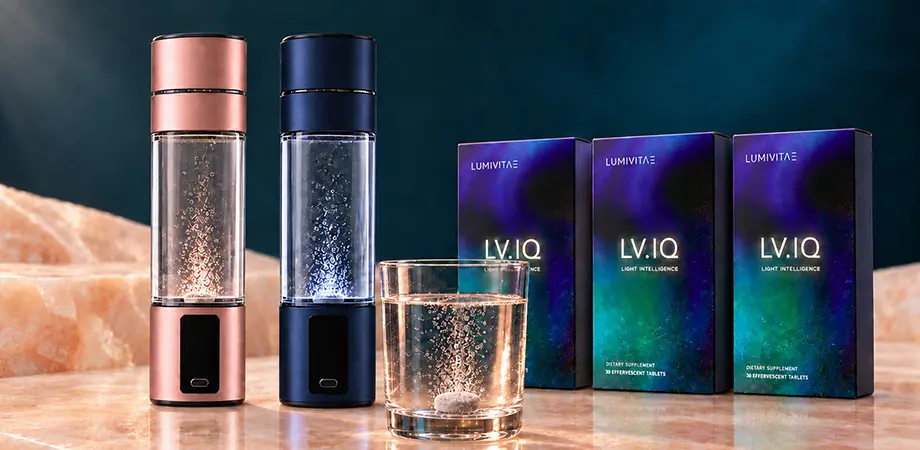
At Lumi Vitae you will find solutions designed to add molecular hydrogen to water in a practical way as part of your daily routine.
If you are interested in Molecular Hydrogen water, understanding how it is generated and which factors influence hydrogen preservation will help you use the devices in a more informed way and make better use of their features.
Discover Lumi Vitae’s solutions and find the option that best fits your routine.
Discover Lumi Vitae’s Solutions for Molecular Hydrogen Water